Why Do We Have to Walk to the General Sherman Tree?
The 0.5-mile walk you take today is more than a trail. It represents a decision to step back so that the world’s largest tree and its forest can remain for future generations.
If you have visited the General Sherman Tree in Sequoia National Park, you may have wondered:

“If this is the world’s largest tree, why didn’t they put the parking lot right next to it?”
Today, most visitors park at the Main Sherman Tree Parking Area off Wolverton Road and walk approximately 0.5 mile (0.8 km) down a paved trail to reach the tree.

The walk usually takes about 10 to 15 minutes. The return trip is uphill, which can feel surprisingly strenuous at this elevation.


But it was not always this way.
In fact, the history of the General Sherman Tree tells a very different story.

When Roads Were Built to Bring People to the Big Trees
In the early years of Sequoia National Park, one of the park’s greatest challenges was not keeping automobiles away from the giant sequoias.
It was finding ways to bring people to them.
In 1903, the Colony Mill Road opened access toward Giant Forest. Originally begun by the Kaweah Colony, the wagon road followed the North Fork of the Kaweah River toward Colony Mill near Giant Forest.
Then, in 1905, Sequoia National Park reached an agreement with the Mount Whitney Power Company.
The company received rights to develop hydroelectric power, and in return it constructed a wagon road known as the Middle Fork Road.
Road construction continued.
By 1913, roads reached Potwisha Camp, Hospital Rock, Buckeye Flat, and Moro Creek Corrals, with another road connecting Giant Forest and Wolverton Creek.
These roads changed the way people experienced Sequoia National Park.
And then came the automobile.
Cars Once Drove Right Up to the General Sherman Tree
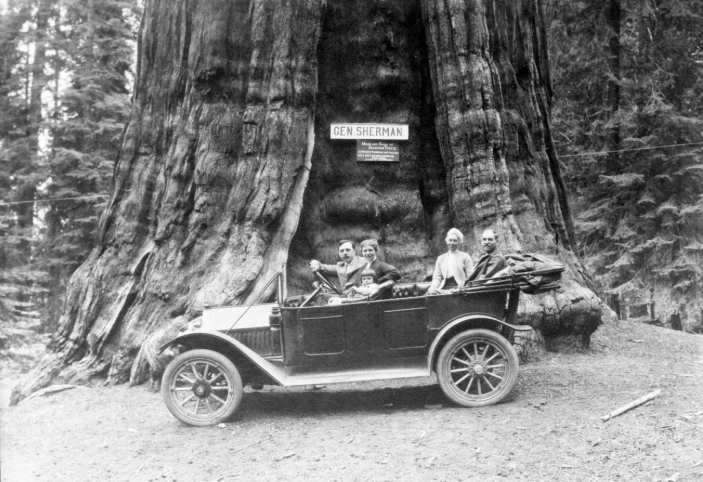
Historic photographs from the early twentieth century show something that is almost unimaginable today.
Automobiles were allowed remarkably close to the General Sherman Tree.

The closer a road could bring visitors to the giant trees, the better the visitor experience seemed to be.
Before automobiles, horses and wagons had traveled through the area. With the arrival of the automobile, increasing numbers of visitors could reach Giant Forest faster and more comfortably.
For visitors, it was wonderfully convenient.
But over time, the forest began paying the price for that convenience.
A Parking Lot Once Stood Near the Sherman Tree
As automobile tourism grew, an entrance road and public parking lot were built near the General Sherman Tree.
For decades, visitors could drive much closer to the tree than they can today. National Park Service records describe visitors searching for spaces in a crowded parking lot, then crossing the entrance road to reach the Sherman Tree.
There was no half-mile walk from a distant parking lot as there is today.
The automobile came to the tree.
It was convenient for visitors. But as roads, cars, and crowds increased, the ground around Giant Forest began to suffer.
The problem was not simply how close people could get to the world’s largest tree.
The real problem was beneath their feet. Was Under Their Feet

When we stand before the General Sherman Tree, we naturally look upward.
Its immense trunk and towering crown command our attention.
But one of the most important parts of a giant sequoia’s environment is beneath our feet.
Giant sequoias depend on the soil surrounding them, and their root systems spread through the upper layers of that soil.
As roads, parking areas, buildings, and increasing numbers of visitors occupied Giant Forest, the ground itself began to change.
Soil became compacted.
Natural drainage patterns were altered.
Erosion increased.

Road and building construction sometimes damaged or severed sequoia roots.
Years of automobile traffic and heavy foot traffic also affected the organic material covering the forest floor.
The problem was bigger than one parking lot.
For much of the twentieth century, Giant Forest contained roads, parking areas, lodging, stores, restaurants, employee housing, and other development among the giant sequoias.
Eventually, the National Park Service faced a different question.
The question was no longer simply:
“How close can we bring people to the trees?”
It became:
“How much should we step back so the forest can recover?”
That change in thinking eventually transformed Giant Forest.
Giving Giant Forest Back to the Forest
By the late twentieth century, the National Park Service had begun one of the most ambitious restoration projects in the history of Sequoia National Park.
Buildings were removed.
Asphalt was taken up.
Compacted soil was loosened.

Natural drainage patterns were restored.
Native vegetation was replanted.
Between 1997 and 2005, the National Park Service reports that 282 buildings were demolished and 231 acres were ecologically restored in Giant Forest.
This was not simply a beautification project.
It represented a fundamental change in how visitors would experience one of the greatest giant sequoia groves in the world.
And eventually, that transformation reached the General Sherman Tree parking lot.
2001–2005: The Parking Lot Moved Away From the Tree
Between 2001 and 2005, the National Park Service removed the old Sherman Tree entrance road and parking lot as part of the Giant Forest restoration project.
Instead of constructing an even larger parking lot beside the tree, the park made a very different choice.
It moved general visitor parking outside the sequoia grove and created a trail connecting the new parking area with the General Sherman Tree.
That decision explains the experience visitors have today.
The parking lot was not placed farther away because planners forgot about visitor convenience.
It was deliberately moved away.
The automobile stepped back.
The forest received more room.
And visitors began walking.
So Today, We Walk 0.5 Mile
Today, most visitors park at the Main Sherman Tree Parking Area off Wolverton Road.
From there, the trail descends approximately 0.5 mile (0.8 km) through the forest to the General Sherman Tree.
At first, the distance may seem unnecessary.
Why make millions of visitors walk when a road could bring them closer?

But once you know the history, that half mile begins to look different.
More than a century ago, automobiles could stand almost at the base of the General Sherman Tree.
Later, visitors drove to a public parking lot close to the tree.
For decades, convenience shaped the visitor experience.
Eventually, however, the park learned something important:

What is convenient for people is not always good for the forest.
So the cars moved back.
And people began to walk.
A 15-Minute Walk Through 100 Years of Change
The 0.5 mile you walk today is more than the distance between a parking lot and a famous tree.
It represents more than a century of changing ideas about how we should experience and protect the natural world.
Once, the goal was to bring the automobile as close to the tree as possible.
Today, we leave the automobile behind.
We close the car door.
We enter the forest on foot.
We pass younger trees.
We walk among giant sequoias.
And eventually, the General Sherman Tree appears before us.
Perhaps those 15 minutes are not wasted time after all.
Perhaps they are part of the experience.
They give us time to slow down before meeting one of the oldest and largest living things on Earth.
The history of this trail teaches us something simple.
A century ago, the automobile went to the tree. Today, the automobile stops—and we walk to the tree.

By stepping back a little, we give the forest a little more room.
And perhaps, because of choices like this, our children and grandchildren will one day walk the same trail and stand beneath the same giant tree.
The 0.5-mile walk is not simply an inconvenience. It is the distance we chose to step back so the forest could move forward.
So the next time you walk those 15 minutes to the General Sherman Tree, remember what once stood much closer to it.
Cars.
Roads.
A parking lot.
And then look at the forest around you.
For the world’s largest tree, fifteen minutes of walking seems like a small price to pay.
Sources & Further Reading
For readers who would like to explore the history behind this story:
National Park Service — Giant Forest Visitor Experience Before Restoration
Leave a Reply