The Tree Everyone Comes to See
Most people come to Sequoia National Park with one tree in mind.
The General Sherman Tree.
It is understandable.
General Sherman is the largest living tree on Earth by volume, and standing beneath it is one of those rare travel experiences where the photographs simply cannot prepare you for the scale.
But something interesting happens around Sherman.
People arrive.
They look up.
They take photographs.
And then many of them turn around and walk back to the parking lot.
I almost want to tell them:
Don’t leave yet. General Sherman is only the beginning.
Because just beyond the most famous tree on Earth begins one of the most beautiful walks in Sequoia National Park.
The Congress Trail.
If General Sherman shows you the greatness of one tree, Congress Trail shows you the greatness of an entire forest.
And this is where Giant Forest begins to reveal something that General Sherman alone cannot show you.
One giant sequoia is astonishing.
But walking through a forest where giants appear again and again is an entirely different experience.


Quick Guide to the Congress Trail
The Congress Trail begins near the General Sherman Tree in the Giant Forest section of Sequoia National Park.
The National Park Service describes it as a paved trail leading through one of the finest concentrations of mature giant sequoias in the park. The official route is generally listed at about 2.7 miles round trip, though park publications and route descriptions sometimes vary depending on the exact starting point and section being measured.
Location: Giant Forest, Sequoia National Park
Trailhead: Near the General Sherman Tree
Distance: Approximately 2.7 miles round trip
Surface: Mostly paved
Difficulty: Easy to moderate
Best for: Giant sequoias, photography, families, quiet forest walking
Reservations: Not required
Pets: Not permitted on the trail
If you need detailed information about parking, shuttles, accessibility, and the walk from the main parking lot, see my Complete General Sherman Tree Visitor Guide. Congress Trail uses the same general access area.
1. The Best Part Begins After General Sherman
There is a noticeable change when you leave the Sherman Tree area.
The crowds begin to thin.
Voices become quieter.
The forest becomes larger.
You stop feeling as though you are visiting an attraction and begin feeling as though you are entering a living forest.
That distinction matters.
General Sherman is a destination.
Congress Trail is an experience.
Congress Trail is where the visit becomes a journey.
The trail moves deeper into Giant Forest, a remarkable grove filled with hundreds of mature giant sequoias. The National Park Service specifically recommends the trail as one of the best ways to experience these ancient trees beyond Sherman.

And slowly, your sense of scale begins to change.
At first, every enormous trunk demands a photograph.
Then another appears.
And another.

And another.
Eventually you realize that what would be a landmark anywhere else is simply another tree here.

That may be the real wonder of Giant Forest.
Not that one enormous tree exists.

It is that enormous trees become almost ordinary because there are so many of them.
General Sherman gives you a record. Congress Trail gives you a world.
2. Look at the Scars Before You Look at the Height
When people first see a giant sequoia, they naturally look up.
I understand why.

These trees can rise hundreds of feet above the forest floor.
But on Congress Trail, I found myself increasingly looking at something else.
The trunks.
Look closely at the photographs.

Many of these trees are scarred.
Some are blackened.
Some have enormous openings near their bases.
Some carry evidence of fires that burned long before any of us were born.
Yet they are alive.
The scars are not hidden.

They have become part of the tree.
Strength is not always living without scars. Sometimes strength is continuing to grow with them.
3. The Senate: Greatness Standing Together
Eventually the trail brings you to one of its most memorable places:
The Senate.

Instead of one famous tree standing alone, several enormous sequoias rise together.
The name is wonderfully appropriate.
They seem gathered for a meeting that began centuries before we arrived.
Standing here feels very different from standing beneath Sherman.
Sherman overwhelms you with the greatness of one.
The Senate overwhelms you with the greatness of many.
Walk between the trunks and human proportions almost disappear.
People become tiny.
The trees become columns.
And the open sky above them begins to resemble the ceiling of an immense cathedral.
We often associate greatness with standing apart.
The tallest.
The largest.
The most famous.
The one everyone photographs.
But the Senate is beautiful precisely because the trees stand together.
Here, greatness is not isolation. It is presence beside presence.
A forest is not simply a collection of individual trees.
Its beauty comes from relationship:
tree beside tree,
root beside root,
generation beside generation.
The Senate may be one of the best places on Congress Trail to understand why Giant Forest is more than a collection of famous trees.
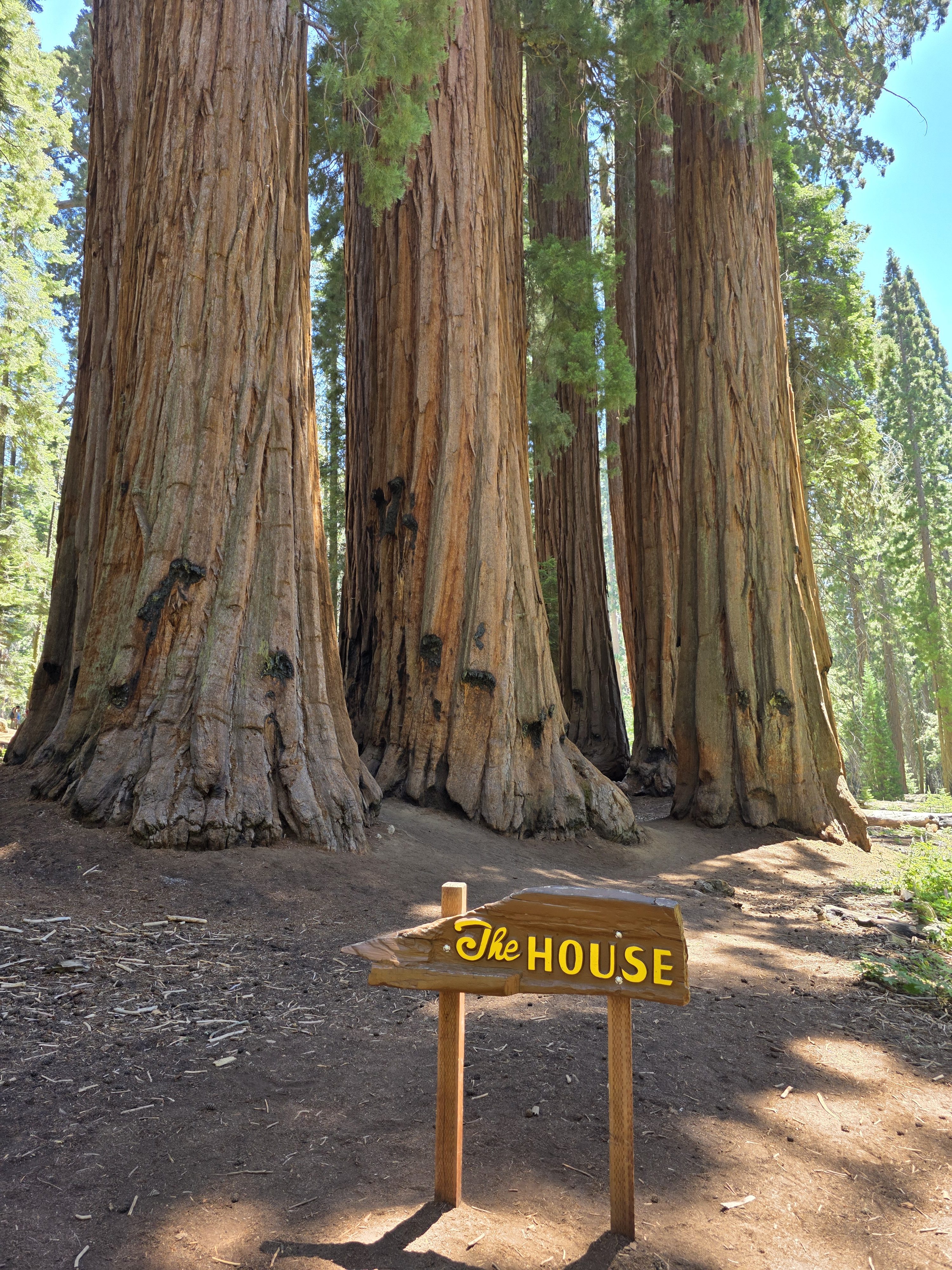
4. The House: Another Community of Giants
Continue along the trail and another gathering appears.
The House.
Again, the name is human.
Again, the trees make our human institutions seem very young.

These trees were standing here long before the United States had a House or a Senate.
Presidents came and went.
Congresses assembled and adjourned.
Generations argued, governed, built, fought, dreamed, and disappeared.
The trees remained.
That is one of the strange gifts of walking among ancient trees.
They rearrange your understanding of time.
Our lives feel long because they are the only lives we have known.
But beneath a giant sequoia, eighty years suddenly feels brief.
A century becomes a chapter.
History becomes something almost visible.
5. Meet the Giants Beyond Sherman
The House and Senate are not the only reasons to continue walking.
Congress Trail and the surrounding Giant Forest trail system bring visitors close to several remarkable named sequoias.

One of the best known is the President Tree, which the National Park Service identifies as the third-largest tree in the world by volume.
The President Tree would be a major destination almost anywhere else. Here, it stands in the shadow of General Sherman—another reminder of just how extraordinary Giant Forest is.
Nearby trails and junctions also lead toward other historic giants, including the McKinley Tree and Lincoln Tree.
McKinley Tree
The McKinley Tree adds another presidential name to this remarkable landscape. But standing beneath it, the human name quickly becomes less important than the tree itself.

Lincoln Tree
The Lincoln Tree carries another familiar name from American history, yet its scale again turns our attention away from politics and toward time.
The names help us remember where we are. The trees remind us how briefly we are here.

This is why I recommend allowing more time here than most visitors expect.
Do not approach Congress Trail as a checklist.
Sherman.
Senate.
House.
President.
McKinley.
Lincoln.
That misses the point.
The named trees help us navigate the forest.
But some of the most beautiful trees you will encounter have no famous sign in front of them.
And perhaps that is one of the trail’s greatest surprises.
Fame and greatness are not the same thing.
6. Slow Down — This Trail Is Not About Miles
You could measure Congress Trail in miles.
But that would be a poor way to measure it.
This is not a trail I would rush.
Stop.
Look upward.
Look at the bark.

Stand between two trunks.
Listen when no one is talking.
Watch how sunlight moves through the canopy.
Notice how small people appear beside the trees.
The National Park Service even suggests watching for Douglas squirrels, or chickarees, which climb the trees, cut sequoia cones and sometimes send them dropping to the forest floor.
Small life continues everywhere beneath the giants.

That contrast is easy to miss if your only goal is reaching the next named tree.
Sometimes the most memorable moment on a trail is not a destination at all.
It is the moment when you stop walking.
7. Why Congress Trail May Be Better Than Visiting Sherman Alone

If you have only a short time in Sequoia National Park, you should absolutely see the General Sherman Tree.
But if you can give the park another couple of hours, keep walking.
Because Sherman answers one question:
How large can a tree become?
Congress Trail asks a deeper one:
What does a forest of ancient giants feel like?
Those are very different experiences.
At Sherman, I found myself measuring.
Height.
Diameter.
Volume.
Age.
Records.
On Congress Trail, those numbers slowly became less important.
I stopped asking how big the trees were.
I simply started walking among them.
And that is when Giant Forest became more than a collection of statistics.
It became a place.
8. What the Giant Forest Taught Me
I came to see giant trees.
But the forest kept pointing toward larger ideas.
The fire scars reminded me that a meaningful life does not require an unscarred life.
The Senate reminded me that greatness does not always stand alone.
The House reminded me how short our institutions and generations are when measured against ancient time.
The fallen trees reminded me that usefulness does not always end when one season of life ends.
And the unnamed giants reminded me that significance does not require recognition.
Perhaps that is why ancient trees affect us so deeply.
They do not hurry.
They do not advertise themselves.
They do not compete for our attention.
They simply keep growing.
Year after year.
Fire after fire.
Winter after winter.
Century after century.
There is a kind of wisdom in that.
We live in a world obsessed with speed.
Grow faster.
Achieve sooner.
Become bigger.
Be noticed.
But nothing about a giant sequoia is fast.
Its greatness is accumulated.
One season at a time.
One ring at a time.
One century at a time.
The forest does not ask how quickly you are growing.
It asks whether you are still growing.
9. Practical Tips for Walking Congress Trail
A few things will make your visit much better.
Start early. The General Sherman area becomes busy, particularly during the summer. An earlier start usually means cooler temperatures and a quieter forest.
Bring water. The trail itself is not extremely difficult, but Giant Forest sits at high elevation. The climb back toward the main Sherman parking area can feel more demanding than expected.
Wear comfortable walking shoes. Much of Congress Trail is paved, but you are still walking several miles at elevation.
Allow at least two hours. You can walk faster, but I would not. Give yourself time for photographs and, more importantly, time to stop.
Do not stop at Sherman. If your schedule allows it, continue into Congress Trail. The transition from a crowded landmark to a quiet grove is part of the experience.
Check current trail conditions. This is particularly important in 2026 because reconstruction is affecting part of the normal Congress Trail route.
For official current information, check the National Park Service Congress Trail page before your visit.
Frequently Asked Questions About Congress Trail
How long is Congress Trail?
The National Park Service currently describes Congress Trail as approximately 2.7 miles round trip, beginning near the General Sherman Tree. Different park materials may show slightly different mileage depending on the starting point and route configuration.
Is Congress Trail difficult?
For most visitors it is an easy-to-moderate walk, and much of the route is paved. However, the elevation and uphill return toward the Sherman parking area can make it feel more strenuous. The NPS notes roughly 200 feet of uphill climbing on the return.
Where does Congress Trail start?
It begins near the General Sherman Tree in Giant Forest.
What trees can I see on Congress Trail?
Highlights include the House and Senate groups and the President Tree, along with many other mature giant sequoias. The broader Giant Forest trail network also connects visitors toward other named trees and destinations.
Is Congress Trail worth hiking after seeing General Sherman?
Absolutely.
In fact, if you enjoy forests rather than simply landmarks, Congress Trail may become the more memorable experience.
General Sherman shows you one extraordinary tree.
Congress Trail shows you why this place is called Giant Forest.
How much time should I allow?
I recommend approximately two to three hours if you want to walk comfortably, photograph the trees, and spend time at the House and Senate groups without rushing.
Can I bring my dog?
No. Pets are not allowed on the trails in Sequoia and Kings Canyon National Parks.
Don’t Turn Around at the Biggest Tree on Earth
There is something almost ironic about visiting the largest living tree on Earth.
You arrive thinking you have reached the climax.
But General Sherman may actually be the beginning.
Walk beyond it.
Follow the paved path into the forest.
Pass the tourists returning to their cars.
Keep going until the conversations grow quieter and the enormous reddish trunks begin appearing one after another.
Walk through the Senate.
Stand beside the House.
Look for the scars.
Walk past trees whose names you know and trees whose names you never will.
Look at the giants still standing.
Look at the giants that have fallen.
And somewhere along the way, stop measuring them.
Just stand there.
Because perhaps the greatest gift of Congress Trail is not seeing how enormous these trees are.
It is discovering how different the world feels when you become small again.
General Sherman may bring you to Giant Forest.
But Congress Trail teaches you to walk among giants.
Leave a Reply