Where is the largest living tree on Earth?
Where is the tallest tree on the planet?
And where is the oldest living organism still breathing today?
Remarkably, all three world records belong to a single place on Earth: California.
- The Largest: The General Sherman Tree (by volume)
- The Tallest: Hyperion (by height)
- The Oldest: Methuselah (by age)
Though these three ancient giants root in entirely different forests and microclimates, they all call California home.
In this guide, we explore how California achieved the ultimate “Tree Grand Slam” of the natural world, and why each of these living miracles holds a profound lesson for us all.
1. The Largest Tree on Earth: General Sherman
When people imagine the “largest tree in the world,” they often think of height. But General Sherman, standing in Sequoia National Park, claims the world title not by soaring highest, but by sheer, overwhelming trunk volume.
- Location: Sequoia National Park
- Species: Giant Sequoia (Sequoiadendron giganteum)
- Height: 274.9 ft (83.8 m)
- Ground Circumference: 102.6 ft (31.1 m)
- Estimated Age: 2,200 to 2,700 years


Most trees taper dramatically as they grow taller. General Sherman, however, maintains an astonishingly thick trunk high up into its canopy. This unique architecture makes it the largest living single-stem tree on Earth, holding enough timber in its trunk to build a modern neighborhood.
When you first stand before General Sherman, its sheer physical size takes your breath away. But as you stay longer and gaze upward, what humbles you even more is the realization that this massive structure has been quietly building itself for over two millennia.
Read More About General Sherman:
🔗 How to Visit the General Sherman Tree: Parking, Shuttle, & Trail Guide
🔗 How Big is the General Sherman Tree? (Soccer Fields, Boeing 747s, & Fact Checks)
2. The Tallest Tree on Earth: Hyperion
If General Sherman represents ultimate mass, Hyperion represents ultimate reach.
Soaring above the foggy canopies of Northern California, Hyperion holds the undisputed title of the tallest living tree on the planet.
- Location: Redwood National and State Parks
- Species: Coast Redwood (Sequoia sempervirens)
- Height: 380.1 ft (115.9 m)
- Estimated Age: 600 to 800 years
At 380.1 feet (115.9 meters), Hyperion stands taller than a 35-story skyscraper or the Statue of Liberty.

Hyperion achieved this impossible height thanks to its unique coastal ecosystem. Thick marine fog rolling in from the Pacific Ocean continuously hydrates its upper canopy during dry summers.
Combined with mild coastal temperatures, heavy winter rain, and deep alluvial soil, Coast Redwoods can reach endlessly toward the sky for centuries.
Why You Can Never Visit Hyperion
Someday, I hope to walk through the forest where Hyperion grows.
Unlike General Sherman, however, Hyperion’s exact location has never been made public.
In July 2022, Redwood National and State Parks closed the entire area surrounding Hyperion to protect its fragile forest ecosystem after increasing visitor traffic severely damaged the forest floor around the tree.
Fortunately, Hyperion is not the only giant worth seeing. Redwood National and State Parks is home to thousands of ancient coast redwoods, many of which can be visited on beautiful, well-maintained trails.
3. The Oldest Living Tree on Earth: Methuselah
The third world record is neither about massive volume nor soaring height.
It is about Time.
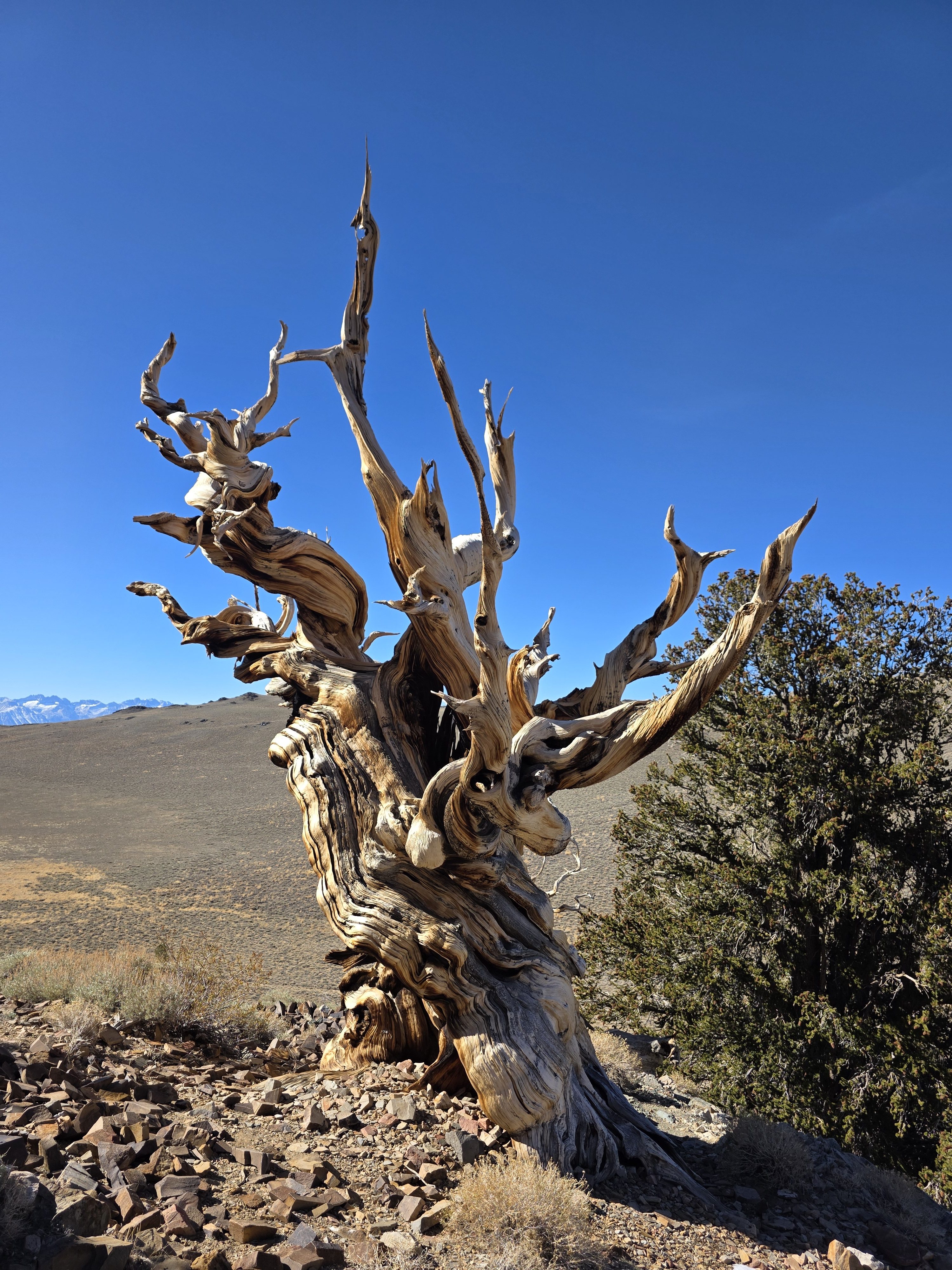
Hidden in the harsh, wind-swept White Mountains of Eastern California grows Methuselah, a Great Basin Bristlecone Pine that has been alive for nearly 5,000 years.
- Location: Ancient Bristlecone Pine Forest (White Mountains)
- Species: Great Basin Bristlecone Pine (Pinus longaeva)
- Estimated Age: Over 4,800 years old
Walking through the Ancient Bristlecone Pine Forest, most visitors are stunned by the trees’ appearance. Expecting towering wooden monarchs, they instead find twisted, gnarled, and weather-beaten trunks that appear more dead than alive.
Yet, this is the secret to their unimaginable longevity.

Bristlecone pines grow at an excruciatingly slow rate—expanding their trunk diameter by just 1/100th of an inch per century. Perched at elevations over 10,000 feet (3,000 meters), they endure freezing alpine winds, severe droughts, and nutrient-poor dolomite soil.
Because they thrive in environments where no other trees can survive, they face virtually no competition, pine beetles, or forest fires.
Standing among them reveals a profound law of existence: The oldest living tree on Earth was not the one that grew fastest, but the one that grew slowest and endured the hardest conditions.

(Note: Like Hyperion, Methuselah’s exact location within the grove is kept secret by the U.S. Forest Service to prevent vandalism.)
Why Are All Three Record-Holders in California?
This remarkable trilogy is no coincidence. California possesses one of the most geographically diverse landscapes on the planet, housing three distinct ecological wonderlands within a single state border:
- The Damp Northern Coast: Pacific fog fuels the soaring height of Coast Redwoods (Hyperion).
- The High Sierra Nevada: Deep winter snowpack and warm summers feed the massive volume of Giant Sequoias (General Sherman).
- The Arid Eastern Mountains: Harsh, barren high-altitude deserts force the ultimate resilience of Bristlecone Pines (Methuselah).
Nature does not measure greatness by a single metric. In California, mass, height, and time coexist in perfect harmony.
A Journey Across California’s Living Miracles
Each giant has taken a completely different path to world record status:
- Visit Sequoia National Park to witness ultimate Mass.
- Explore Redwood National Park to feel ultimate Height.
- Ascend the White Mountains to contemplate ultimate Time.
To travel across these three forests is more than a road trip. It is a pilgrimage through three different expressions of nature’s timeless wisdom.
May your own journey take inspiration from California’s giants—whether you are building mass, reaching higher, or simply enduring through time.
Leave a Reply